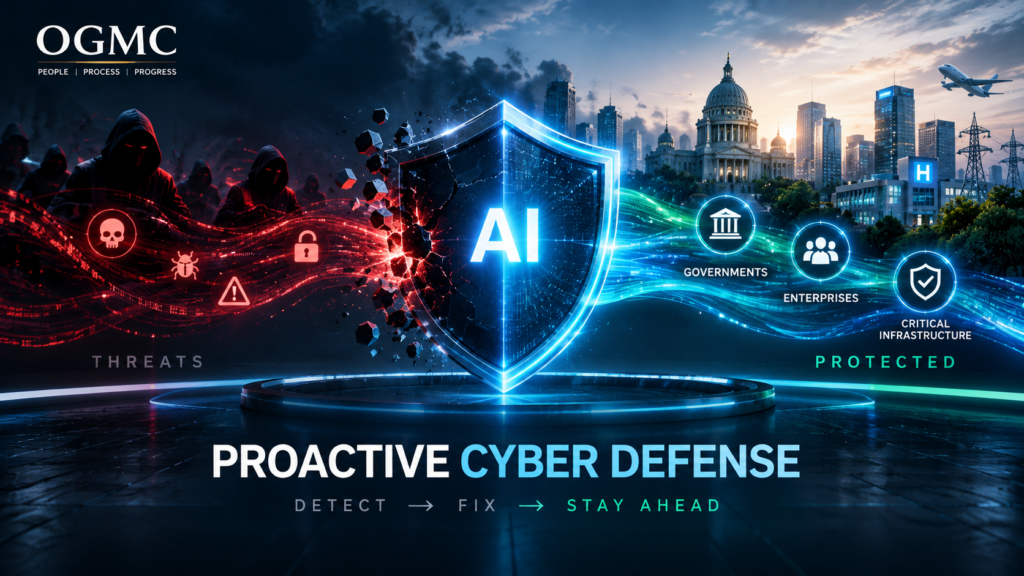
Proactive Cyber Defense: Moving from Detection to Autonomous Protection
Cybersecurity is entering a new phase. As attackers increasingly leverage automation and AI to discover vulnerabilities faster, organizations can no longer rely solely on traditional detection, monitoring, and manual remediation.
The real advantage lies in reducing the time between identifying a vulnerability and fixing it.
From Finding Vulnerabilities to Fixing Them
For governments and large enterprises, vulnerability remediation can be complex. Critical systems, extensive codebases, regulatory requirements, and limited cybersecurity resources often mean that even identified vulnerabilities can remain unresolved for weeks.
Advanced AI is changing this equation.
Google’s Fairwind Program brings advanced Gemini cybersecurity capabilities together with CodeMender to help trusted government agencies, enterprises, and cybersecurity partners identify, validate, and autonomously fix software vulnerabilities.
Instead of simply highlighting weaknesses, AI can assist defenders in generating and validating deployment-ready fixes within secure environments.
Why Proactive Defense Matters
The cybersecurity challenge is no longer simply:
“Can we detect the threat?”
It is increasingly:
“How quickly can we eliminate the vulnerability before it is exploited?”
This shift is particularly important for organizations responsible for critical infrastructure, public services, financial systems, telecommunications, healthcare, and widely used technology platforms.
Giving defenders advanced AI capabilities earlier can create a valuable security advantage—allowing organizations to strengthen their systems before emerging attack techniques can be effectively weaponized.
The OGMC Perspective
AI is transforming cybersecurity from a predominantly reactive discipline into a more proactive and automated capability.
However, autonomous security requires more than powerful models. It requires strong governance, controlled access, secure infrastructure, clear accountability, and disciplined implementation.
For enterprises and governments, the objective should not simply be to adopt AI for cybersecurity. It should be to integrate AI into a responsible security strategy that continuously identifies, prioritizes, and resolves risk.
The future of cyber defense will increasingly be defined by speed, intelligence, and proactive execution.
Organizations that can move from detecting vulnerabilities to rapidly fixing them will be better positioned to protect critical systems and maintain resilience against increasingly AI-driven threats.
The strongest defense is no longer just knowing where the vulnerability is, it is eliminating it before the attacker can use it.