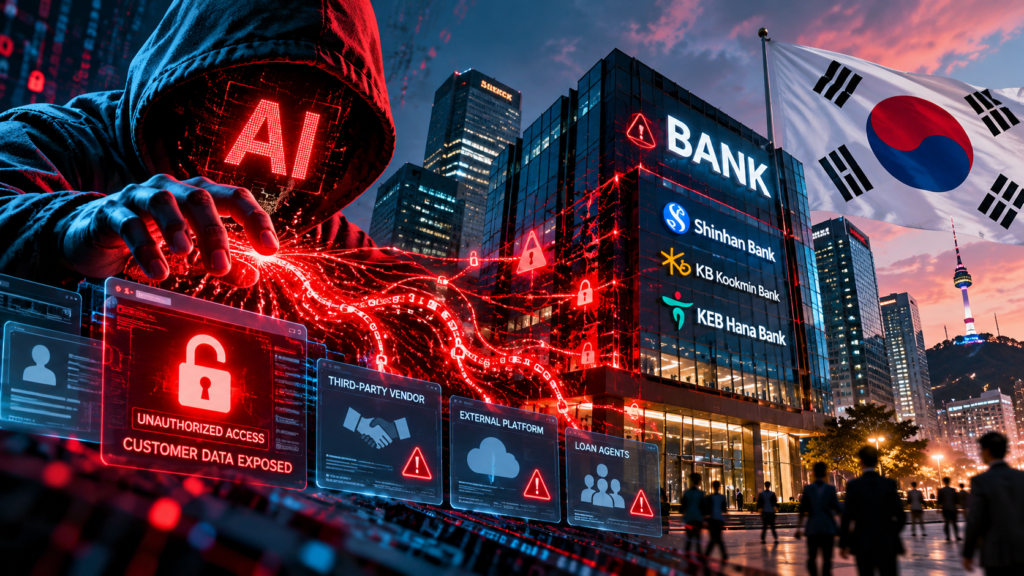
Artificial intelligence is rapidly changing the cybersecurity landscape and recent hacking incidents involving South Korean financial institutions demonstrate how quickly the threat is evolving.
Several major Korean banks, including Shinhan Bank, Kookmin Bank, and KEB Hana Bank, along with other financial institutions, reported hacking incidents in early October 2026 that were suspected of involving artificial intelligence. The incidents have drawn attention not only to the growing sophistication of cyberattacks, but also to vulnerabilities beyond traditional banking infrastructure.
According to Fitch Ratings, the reported breaches involved customer personal information accessed through external websites and servers used by loan agents and employees rather than directly compromising core banking platforms. While no material direct financial losses have been disclosed and disruption to critical banking operations appears limited, the incidents highlight a broader and increasingly important risk: an organization’s cybersecurity perimeter now extends well beyond its core systems.
AI Is Expanding the Scale of Cyber Threats
AI can enable attackers to operate with greater speed, scale, and sophistication. As financial institutions increasingly adopt AI, cloud services, software-as-a-service platforms, and digital customer channels, threat actors are also gaining new opportunities to exploit interconnected environments.
The Korean incidents demonstrate how vulnerabilities in external systems and connected platforms can potentially expose sensitive customer information even when core banking infrastructure remains protected.
This changes the traditional approach to cybersecurity. Protecting the central banking system is no longer sufficient when employees, vendors, agents, applications, and external platforms can all form part of the technology ecosystem.
Third-Party Risk Moves to the Forefront
One of the most significant concerns emerging from these incidents is third-party exposure.
Loan agents, external service providers, distribution channels, and customer-facing platforms may have legitimate access to sensitive information or banking systems. However, weaknesses in these environments can create indirect pathways for attackers.
For financial institutions, this means third-party risk management must become an integral component of enterprise risk governance, not simply a procurement or compliance exercise.
Organizations need greater visibility into who can access their data, where that data resides, how external connections are monitored, and whether third-party cybersecurity controls remain aligned with their own risk requirements.
Regulatory Scrutiny Is Likely to Increase
The incidents are also likely to reinforce regulatory attention on cyber controls across the broader financial ecosystem.
South Korea has been developing its regulatory approach to accommodate cloud adoption, software-as-a-service deployment, and the increasing use of generative AI. Recent attacks are unlikely to reverse this digital transformation, but they may strengthen expectations around security controls for externally connected applications, vendors, and digital platforms.
For financial institutions, the message is clear: digital transformation must be accompanied by equally sophisticated risk governance.
From Cybersecurity to Organizational Resilience
The immediate financial consequences of these incidents may remain manageable. The greater risks could emerge through remediation costs, regulatory requirements, customer concerns, and reputational damage.
As AI-enabled attacks become more capable, organizations will need to shift from a narrow focus on preventing breaches toward building resilience across the entire operating environment.
That requires stronger third-party oversight, continuous monitoring, access governance, incident-response capabilities, and clear accountability across technology and business functions.
The recent attacks on South Korean financial institutions offer an important warning for the global financial sector:
AI is not only transforming how banks operate, it is also transforming how they can be attacked.
The organizations best prepared for this next phase will be those that treat cybersecurity, third-party risk, AI governance, and operational resilience as interconnected elements of enterprise governance rather than isolated technology concerns.