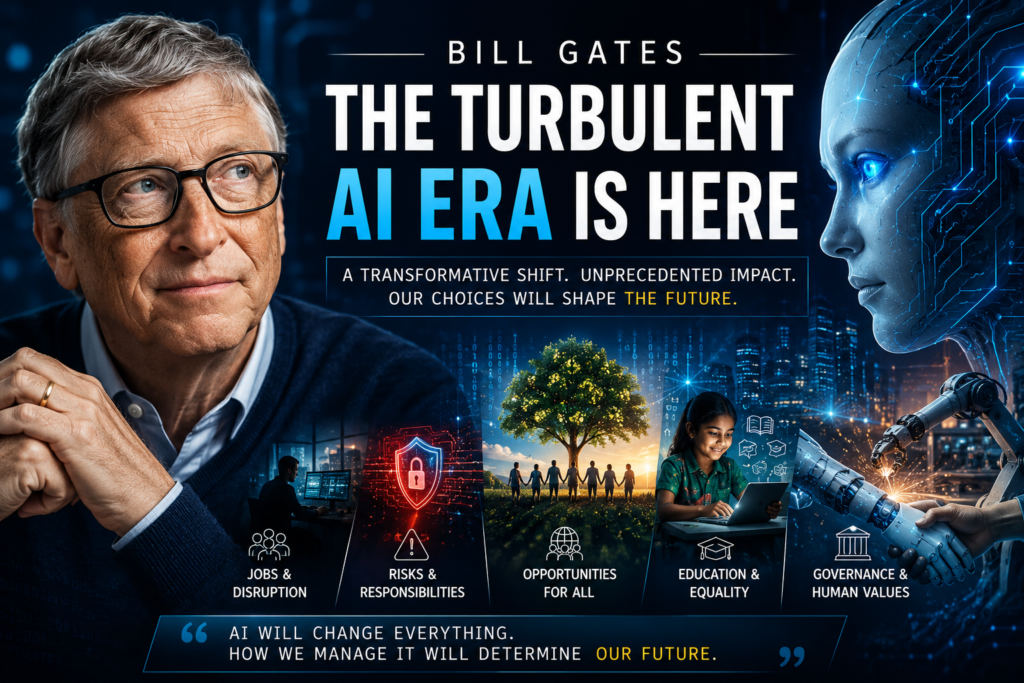
Bill Gates argues that AI is entering a period of extraordinarily rapid transformation, and that society must prepare before the disruption becomes overwhelming. He sees AI as having the potential to become either a powerful force for equality or a major driver of inequality.
Key points:
AI will transform work rapidly.
Unlike previous technological revolutions, AI can replace aspects of human cognitive work and spread quickly across industries. Entry- and mid-level jobs could face particularly significant disruption, while new roles may require substantially different skills.
AI creates serious risks.
Gates highlights job displacement, cybercrime, fraud, misinformation, deepfakes, surveillance, and the possibility that increasingly autonomous AI systems could become difficult to control.
Young people may be especially affected.
Fewer entry-level jobs could make it harder for young workers to gain the experience traditionally needed to build professional careers. Gates also warns that excessive dependence on AI companions could affect social development and critical-thinking skills.
The benefits could be enormous.
AI could accelerate scientific research, improve healthcare, support farmers, make government services easier to access, personalize education, and give individuals and small businesses capabilities that previously required expensive specialists.
AI must benefit developing countries too.
Gates particularly emphasizes healthcare, agriculture, education, and access to AI in different languages as areas where AI could help reduce global inequality.
Governments need a coordinated transition plan.
Existing institutions were not designed for a technology that simultaneously affects employment, education, healthcare, national security, taxation, energy, elections, and other sectors. Gates calls for new national and international frameworks for AI governance.
Some work may need to remain human.
Gates proposes the concept of “Human Reserved”—areas where society deliberately chooses to retain human involvement because human judgment, empathy, dignity, or social value matters even when machines could technically perform the task.
Tax systems may need to change.
Gates proposes considering taxes on AI and robots to counterbalance the existing tax advantage of replacing human labor with machines and to help fund worker retraining and social support.
The central message
AI development cannot realistically be stopped, so the priority should be managing its transition responsibly.
Gates’ position is neither purely optimistic nor pessimistic. He believes the world should maximize AI’s benefits while actively reducing its social and economic harms. The most important decisions are therefore not about whether AI will advance, but about how society distributes its benefits, protects vulnerable people, preserves meaningful human roles, and governs increasingly powerful AI systems