Beyond ChatGPT: The Rise of World Models and the Next Era of AI
Artificial intelligence is entering its next strategic phase.
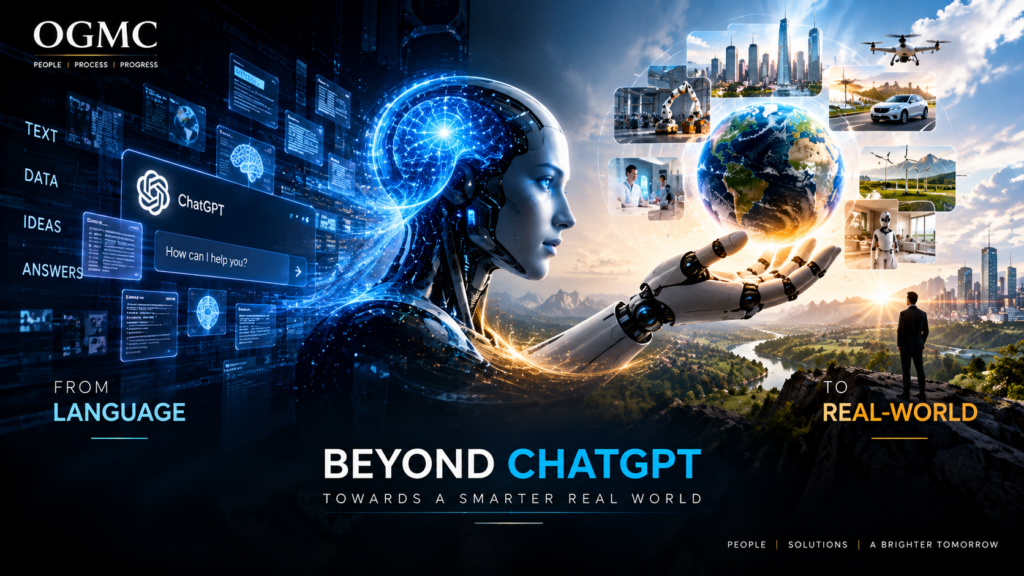
Today’s leading AI systems such as ChatGPT, Claude, and Gemini are exceptionally capable at language, coding, mathematics, and information processing. Yet a fundamental limitation remains: they do not truly understand the physical world in the way humans and animals do.
The next breakthrough in AI may therefore not come simply from building larger language models, but from developing systems that can understand environments, predict consequences, and make decisions based on how the real world works.
From Language Models to World Models
Large Language Models are fundamentally designed to process and generate information from patterns in data. This makes them extremely powerful for well-defined tasks.
But the physical world is unpredictable.
A robot stacking dishes, handling an object, navigating a room, or performing household work must understand cause and effect, spatial relationships, uncertainty, and the consequences of different actions.
This is where a new generation of AI research is emerging: World Models.
Rather than simply predicting the next piece of information, World Models attempt to build an internal representation of how the world operates. These representations can help AI evaluate possible outcomes before taking action.
The JEPA Approach
AI pioneer Yann LeCun is among the strongest advocates for this direction.
Through Advanced Machine Intelligence Labs (AMI Labs), LeCun is developing Joint Embedding Predictive Architecture (JEPA) an approach designed to help AI reason about the world through meaningful abstractions rather than relying solely on statistical prediction.
The objective is significant:
AI should learn what matters, understand relationships, and predict the consequences of actions not simply reproduce patterns from its training data.
Why This Matters for Robotics
The robotics industry is investing billions in humanoid and autonomous machines. Yet creating robots capable of safely performing complex real-world tasks remains difficult.
A robot cannot rely solely on language.
It needs to understand:
- What is happening?
- What matters?
- What caused it?
- What could happen next?
- What will happen if I take a different action?
This is precisely the type of reasoning that World Models aim to enable.
Researchers at Oxford and organizations including Google DeepMind and other AI laboratories are also exploring related approaches, demonstrating that the industry is increasingly looking beyond traditional language-model architectures.
The Strategic Shift
The next generation of AI could therefore represent a fundamental transition:
From generating answers → to understanding environments.
From recognizing patterns → to modelling consequences.
From responding to instructions → to reasoning about actions.
This evolution could transform robotics, autonomous systems, industrial automation, transportation, healthcare, manufacturing, and countless other sectors.
The OGMC Perspective
The most important question about the future of AI may not be how intelligent machines become, but how effectively humans direct that intelligence.
Even as AI systems become increasingly autonomous and potentially surpass human capabilities in specific areas, humans will remain responsible for defining objectives, asking the right questions, deciding what should be created, and determining how technology should serve society and business.
The emerging AI landscape points toward a powerful partnership:
Machines provide intelligence, scale, and execution.
Humans provide purpose, judgment, creativity, and direction.
For organizations, this means the AI opportunity is moving beyond automation and productivity. The real competitive advantage will increasingly come from understanding how emerging AI architectures can reshape decision-making, operations, workforce capabilities, and long-term strategy.
The Future of AI May Not Be About Bigger Models.
It May Be About Smarter Understanding.
And when machines can understand the world not merely describe it the boundary between artificial intelligence and real-world intelligence may begin to disappear.