
The AI Investment Boom: Opportunity or Disaster?
The AI Spending Boom: Is the Bubble Really About to Burst?
Artificial intelligence has become one of the biggest investment stories in modern economic history. Companies are pouring unprecedented amounts of capital into chips, data centers, electricity, networking and computing infrastructure. Investors, meanwhile, are beginning to ask an increasingly uncomfortable question: How long can this spending continue before the AI boom turns into a bubble that finally bursts?
The answer may be more complicated than it appears.
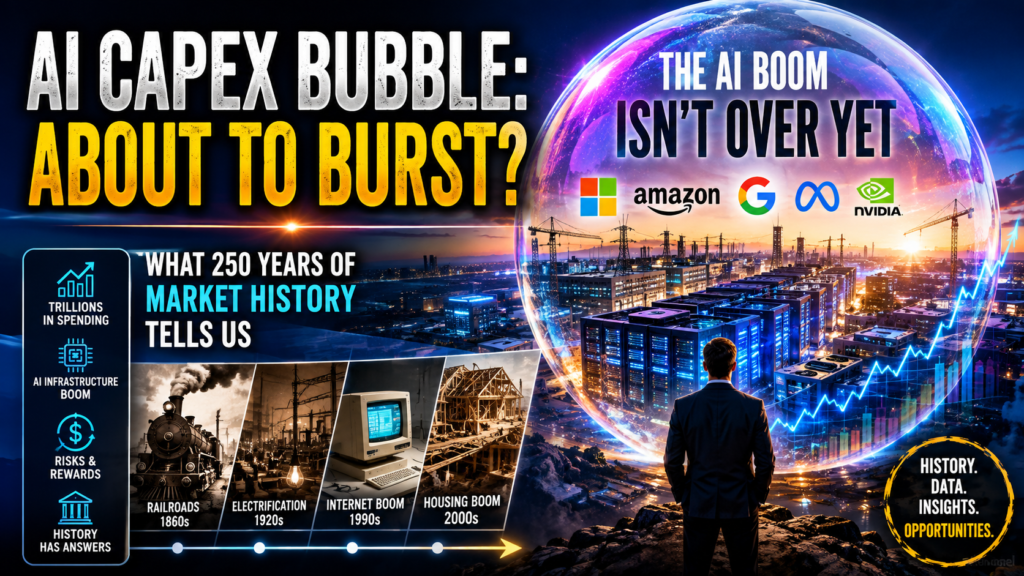
Historical market cycles suggest that transformational technology booms rarely end precisely when investors expect them to. Railroads, electrification and the internet all experienced extraordinary periods of capital investment before eventually suffering painful corrections. Yet those corrections did not erase the underlying technologies or the infrastructure that had been created.
That history offers an important perspective on today’s AI revolution.
AI Capital Spending Has Reached Extraordinary Levels
The scale of today’s AI investment is difficult to ignore.
Since the beginning of 2024, hundreds of billions of dollars have flowed into AI-related chips, power infrastructure, construction and networking. At the same time, the world’s largest technology companies are preparing to spend trillions more on AI infrastructure over the coming years.
Companies such as Microsoft, Amazon, Alphabet and Meta are dramatically increasing their capital expenditures as they race to build the computing capacity required for increasingly sophisticated AI systems.
The transformation is particularly striking when compared with previous technology cycles.
AI infrastructure spending is no longer simply an IT investment. It is becoming a major driver of construction, electricity demand, semiconductor production, networking equipment, cooling systems and data-center development.
In other words, AI has evolved into an economy-wide capital-spending cycle.
The Biggest Change: AI Is No Longer Being Funded Only by Cash
For years, investors were relatively comfortable with Big Tech’s AI spending because companies could largely finance their investments through enormous operating cash flows.
That dynamic is beginning to change.
The scale of projected investment means companies increasingly need to consider equity markets, debt markets, private credit and alternative financing structures.
This introduces a new risk into the AI story.
The more dependent the AI buildout becomes on external financing, the more sensitive it becomes to interest rates and credit conditions. If borrowing costs rise substantially, projects that appear attractive today could become significantly more expensive tomorrow.
That makes the bond market and the Federal Reserve increasingly important to the future of the AI trade.
History Says the Boom May Have Further to Run
One of the most interesting arguments is based on America’s long history of transformational capital spending.
Previous investment booms have occurred around technologies that fundamentally changed how the economy operated.
The railroad expansion transformed transportation and commerce. Electrification reshaped industry and households. The internet created an entirely new digital infrastructure.
Each cycle eventually experienced excess investment and financial stress.
But these bubbles did not necessarily burst simply because investors began talking about a bubble.
They generally required a catalyst.
That catalyst could be higher interest rates, tighter monetary policy, an economic shock or another unexpected event that exposed weaknesses in the financial system.
This historical pattern suggests that today’s AI spending may still have room to grow.
The “Rule of 25”
The article highlights an intriguing historical benchmark: transformational capital-spending cycles have historically been able to reach roughly 25% of economic output before the financial system begins facing much greater stress.
With the U.S. economy now around $30 trillion, that would place a theoretical danger zone near $7.5 trillion.
Current AI investment remains below that threshold.
That does not mean the AI boom cannot collapse earlier. Markets are unpredictable, and historical comparisons are not perfect.
But it does suggest that, from a purely top-down economic perspective, the United States may still be capable of absorbing considerably more AI investment before the buildout reaches the scale associated with previous major capital-spending crises.
The Critical Question: Is AI Actually Becoming Profitable?
This may ultimately determine whether the current AI boom becomes a sustainable economic transformation or simply another investment bubble.
A capital-spending boom becomes much healthier when spending eventually produces sufficient revenue and profits to finance the next stage of growth.
There are already signs that this is happening.
Cloud businesses are experiencing rapid growth, AI companies are generating increasingly significant revenues, and demand for computing capacity remains exceptionally strong.
This distinction is critical.
If companies continue spending enormous sums without generating meaningful economic returns, investors will eventually question the entire investment thesis.
But if AI infrastructure generates rapidly expanding revenue and productivity gains, today’s massive spending could begin to look less like speculation and more like the construction of a new economic foundation.
Financing Could Become the Weakest Link
Despite the enormous opportunity, financing remains one of the biggest potential vulnerabilities.
The AI industry may require several trillion dollars of additional infrastructure investment over the next several years. Funding that scale of spending will require participation from virtually every major source of capital.
That includes:
-
Corporate cash flow
-
Public equity markets
-
Corporate debt
-
Private credit
-
Alternative financing structures
-
Strategic partnerships
-
Potential government involvement
The more complicated the financing becomes, the greater the potential for financial stress if economic conditions deteriorate.
Rising long-term Treasury yields could be particularly damaging. Higher yields would increase the cost of borrowing and could pressure valuations for companies whose future growth depends heavily on continued investment.
Credit Markets Are Already Watching
There are already signs that investors are becoming more cautious.
Credit-default swap costs for major technology companies have risen, indicating that the market is assigning somewhat greater risk to the possibility of corporate credit deterioration.
However, this should not be confused with an immediate financial crisis.
The major hyperscalers remain financially powerful businesses with enormous earnings capacity and comparatively strong balance sheets.
The message from credit markets is therefore not necessarily “collapse is coming.”
It is closer to “the risks are becoming more visible.”
The AI Opportunity Is Expanding Beyond Chips
Another major shift is occurring within the AI investment landscape.
The first phase of the AI boom was heavily focused on computing power and advanced semiconductors.
The next phase could be much broader.
As AI systems become larger and more complex, companies will need massive amounts of:
Power. Cooling. Networking. Memory. Storage. Data centers. Connectivity. Software.
This creates an increasingly diverse AI infrastructure ecosystem.
The companies benefiting from AI may therefore not always be the companies building the AI models themselves. Some of the most important beneficiaries could be the companies supplying the physical infrastructure required to operate them.
That makes the AI investment story increasingly similar to previous infrastructure revolutions.
What Happens When the Bubble Eventually Bursts?
This is perhaps the most important point.
The AI spending boom will eventually slow.
Some companies will spend too much. Some projects will fail to generate adequate returns. Valuations will eventually become excessive in certain parts of the market. And when the cycle turns, investors could experience a significant correction.
But a financial bubble bursting does not necessarily mean that the technology itself has failed.
The railroads eventually experienced a massive financial crisis. Internet stocks eventually collapsed. Housing experienced a devastating bubble.
Yet the infrastructure created during those periods remained.
Railroads continued to transport goods.
Internet infrastructure became the foundation of the digital economy.
Electricity networks continued powering industrial development.
The same could happen with AI.
If today’s spending creates a vast global network of computing infrastructure, power capacity and data centers, that infrastructure could remain valuable long after today’s hottest AI stocks have disappeared or dramatically declined.
The Real Investment Question
The question may therefore not be whether there is an AI bubble.
There almost certainly is some degree of excess within such an enormous investment cycle.
The more important question is:
Has the AI boom reached the point where the financial system can no longer absorb the spending?
Historical evidence suggests that we may not be there yet.
The AI buildout remains enormous, but the underlying demand is real. Revenues are growing. Infrastructure is being deployed at unprecedented speed. Major technology companies continue to generate substantial cash flows. And the amount of capital invested in AI remains below the historical levels that have preceded some of America’s most severe transformational investment crises.
That does not make the market safe.
It simply means that investors who are abandoning the AI story purely because they fear an imminent bubble burst may be acting too early.
The Bigger Picture
Every major technological revolution creates both extraordinary opportunities and extraordinary excess.
The railroad boom built too many railways.
The internet boom built too much fiber.
The housing boom built too many homes.
And the AI boom will almost certainly build too much computing infrastructure.
But excess investment can still create lasting economic value.
The most important distinction is between the bubble and the technology.
The bubble may eventually burst.
The technology may continue transforming the economy for decades.
For investors, businesses and policymakers, the challenge is therefore not simply deciding whether AI is a bubble. It is understanding where we are in the cycle, how the spending is being financed, whether the infrastructure is generating real returns, and what could ultimately trigger the downturn.
For now, history suggests that the AI music may still be playing.
The difficult part, as always, will be knowing when it is finally time to stop dancing.