AI Transformation: Redesign Work, Don’t Just Cut Roles
Artificial intelligence is reshaping the workplace, but organizations risk making a critical mistake: treating AI transformation as a headcount-reduction exercise.
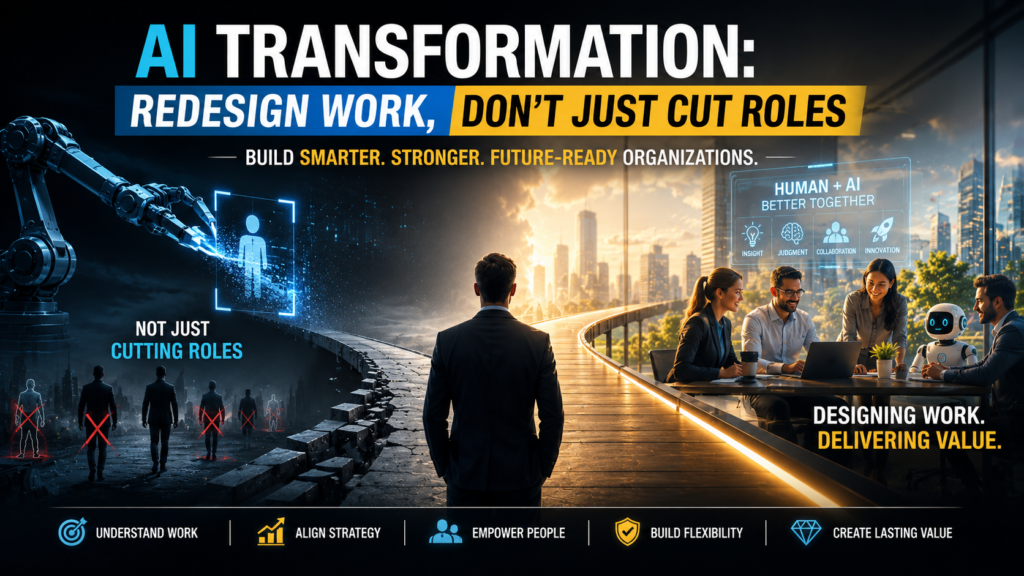
The real opportunity is not simply to replace people with technology. It is to redesign how work gets done, combining human expertise with AI capabilities to create smarter, more adaptable organizations.
AI Layoffs Don’t Tell the Full Story
AI-related layoffs are receiving significant attention, but the actual impact of AI on employment remains uncertain. Many workforce reductions described as AI-driven may also involve broader restructuring, cost pressures or previous over-hiring.
More importantly, organizations are discovering that AI-driven workforce decisions can be difficult to get right. Some companies have reduced staff only to discover that AI still requires significant human oversight, institutional knowledge and judgment.
The lesson is simple:
AI transformation should be based on evidence—not expectations.
Start With Work, Not Headcount
A job is rarely one task. Employees combine technical activities with communication, collaboration, decision-making, relationship management and judgment.
Replacing an entire role because some of its tasks can be automated can therefore create unexpected capability gaps.
A better approach is to first identify:
-
What AI can automate
-
What AI can augment
-
What requires human judgment
-
What processes should be redesigned
-
What capabilities the future organization will need
Only then should workforce decisions be made.
AI Strategy Must Support Business Strategy
AI should not be treated simply as a cost-cutting tool.
Organizations should ask:
“How can AI help us execute our strategy better?”
Efficiency gains may reduce some roles, but they can also free employees to focus on customers, innovation, revenue generation, strategic decisions and complex problem-solving.
The objective is not necessarily a smaller workforce.
It is a more capable workforce.
Human Judgment Still Matters
AI can analyze information and automate many activities, but organizations still need human accountability, ethical judgment, contextual understanding and leadership.
This makes effective management and oversight especially important.
Removing human layers without understanding their organizational value can create risks that technology alone cannot solve.
Build for Flexibility
AI capabilities are evolving quickly, making irreversible workforce decisions particularly risky.
Organizations should consider reskilling, internal mobility, redeployment, attrition and phased restructuring before large-scale layoffs wherever practical.
Experienced employees carry institutional knowledge and relationships that can be extremely difficult and expensive to rebuild.
The OGMC Perspective
Successful AI transformation requires organizations to redesign work, processes, capabilities and governance—not simply reduce headcount.
Leaders should measure transformation through productivity, decision quality, customer outcomes, innovation and business value—not layoffs alone.
The most successful organizations will not necessarily be those with the fewest employees.
They will be the organizations that understand where AI creates value, where humans remain essential, and how both can work together effectively.
AI should make organizations smarter—not simply smaller.