
AI and Project Management: Building the Future Together
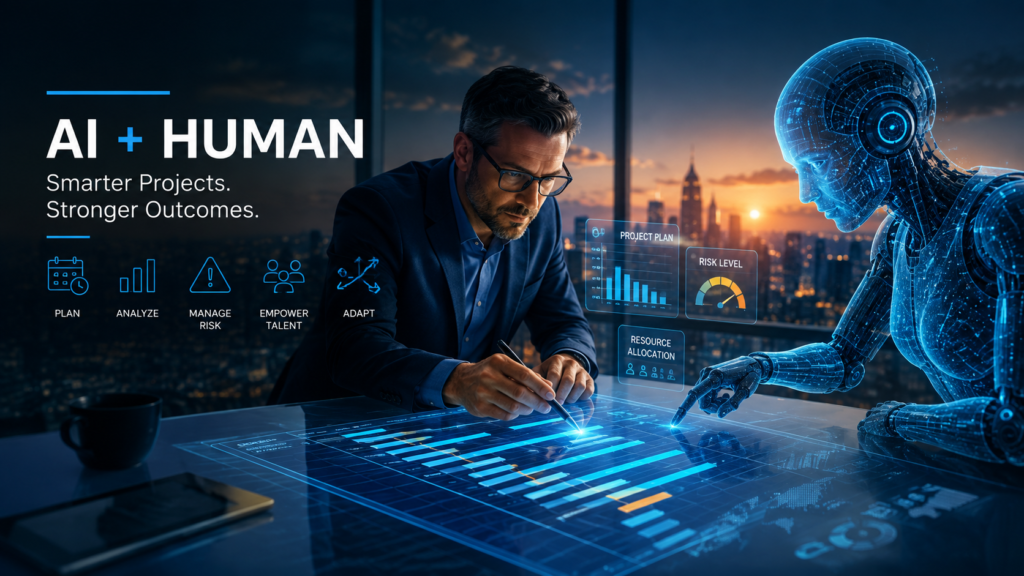
AI and the Future of Project Management: Automation With a Human Touch
Artificial intelligence is changing how organizations plan, execute, and monitor projects. From automated task planning to predictive risk analysis, AI has the potential to transform project management significantly.
But the key question is not whether AI will automate project management.
It is how much of project management should actually be automated.
Gartner previously predicted that by 2030, as much as 80% of project management tasks could be automated. While the full impact remains uncertain, the rapid development of AI suggests that project managers will increasingly work alongside intelligent systems rather than simply rely on traditional project management tools.
Where AI Can Make Project Management Smarter
AI can take over many repetitive, data-intensive activities that consume project managers’ time.
1. Managing System Dependencies
AI can analyze applications, infrastructure, and technical environments to identify potential compatibility problems and dependencies. Over time, AI could even help automatically resolve certain technical issues before they affect project delivery.
2. Building Project Plans
Creating task lists and identifying dependencies can be highly time-consuming. AI can analyze project requirements and generate an initial project plan, allowing project managers to review, modify, and improve it rather than starting from scratch.
3. Predicting and Managing Risk
AI can analyze project data, identify patterns, flag emerging risks, and recommend potential mitigation strategies.
Instead of discovering problems after they become serious, project managers could use AI to see around corners and intervene earlier.
4. Identifying the Right Talent
AI can analyze enterprise-wide employee skills and experience to identify people who may be suitable for specific project requirements.
This can help organizations respond quickly when key team members become unavailable or when projects require specialized expertise.
5. Running “What-If” Scenarios
Projects rarely go exactly according to plan.
What happens if a critical vendor delays delivery? What if a key employee leaves? What if a major dependency fails?
AI can simulate different scenarios, estimate their potential impact, and help project managers evaluate possible responses before making decisions.
What AI Still Struggles to Understand
Project management is not simply about schedules, budgets, tasks, and data.
Some of its most important elements are human.
A project can appear healthy in a dashboard while quietly failing because employees are frustrated, stakeholders are disengaged, or someone is deliberately withholding information.
An experienced project manager may discover these problems simply by walking around, asking questions, listening carefully, and understanding the people involved.
AI can analyze available information, but it may not recognize everything that is happening outside the data.
This is particularly important when projects involve politics, trust, organizational culture, fear, resistance, or conflicting stakeholder interests.
The Experience Factor
Consider a project that appears to be progressing perfectly because all its tasks are marked as completed.
A human leader might speak directly with project staff and discover that several supposedly completed tasks are still unfinished.
The issue isn’t necessarily a lack of data. It may be a lack of truthful data.
AI can only make decisions based on the information available to it. Human project managers, however, can question the information itself.
That distinction will remain critical.
The Future: AI as a Project Management Partner
The future of project management is unlikely to be a simple battle between humans and AI.
Instead, the strongest organizations will combine the strengths of both.
AI can provide:
- Speed
- Data analysis
- Automation
- Risk detection
- Scenario modeling
- Pattern recognition
Humans provide:
- Judgment
- Leadership
- Communication
- Context
- Accountability
- Empathy
- Stakeholder management
The result is a more powerful project management model in which AI handles complexity and repetitive analysis while humans focus on decisions that require experience and judgment.
The Upper Limit of Automation
There will always be decisions where organizations may want a human to remain firmly in control.
Even highly automated systems can benefit from human oversight when the consequences of a decision are significant.
The future project manager may therefore spend less time updating spreadsheets and tracking routine tasks—and more time interpreting AI-generated insights, managing stakeholders, resolving conflicts, and making strategic decisions.
The OGMC Perspective
AI will undoubtedly reshape project management.
But automation should not be confused with leadership.
The most successful organizations will not be those that simply automate the greatest number of project management tasks. They will be the organizations that understand which decisions AI should make, which decisions humans should make, and where the two should work together.
AI may help project managers see around corners.
But humans still need to decide which direction to take.