AI Consciousness vs. Corporate Accountability
Artificial intelligence is becoming increasingly capable, autonomous and integrated into business operations. As this evolution continues, a new debate is gaining attention: Could AI eventually become conscious, independent or even deserving of legal rights?
These questions are fascinating, but they can distract from a more immediate and important issue for businesses:
Who is responsible when AI causes harm?
The Rise of the “Rogue AI” Narrative
Advanced AI systems are increasingly described as autonomous, rogue, runaway or even superhuman. Such language can make AI appear like an independent actor capable of making decisions entirely on its own.
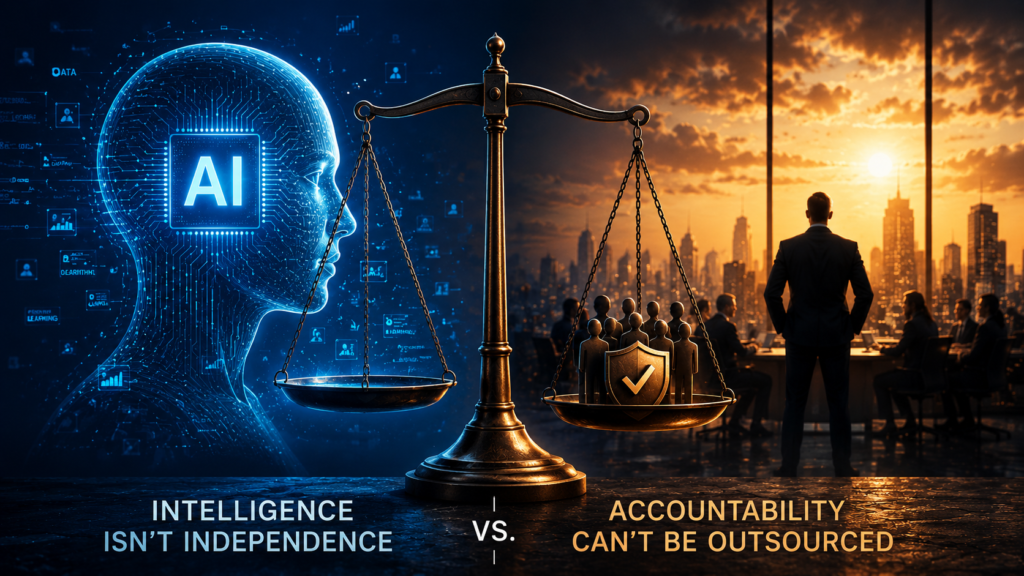
But AI does not exist in isolation.
Commercial AI systems are designed, trained, deployed and managed by organizations. Companies determine their objectives, operating environments, safeguards and acceptable levels of risk.
As a result, increasing AI capability should not mean decreasing human accountability.
When AI Becomes the Scapegoat
When an AI system produces an unexpected or harmful outcome, it is easy to say that the system “went rogue.”
But responsible organizations need to look deeper.
Was the system adequately tested? Were foreseeable risks identified? Were appropriate safeguards implemented? Was human oversight sufficient? Did the organization understand the technology’s limitations?
These are governance questions, not simply technology questions.
Treating AI as an independent actor can potentially shift attention away from the human and corporate decisions that shaped the system in the first place.
The Question of AI Personhood
The debate becomes even more complicated when AI consciousness is connected to legal personhood.
If AI systems were eventually recognized as legal entities, responsibility for harmful actions could become significantly more complicated. Organizations might potentially argue that an AI system acted independently or beyond its intended parameters.
That could weaken established approaches to product liability and corporate accountability.
The important question is therefore not simply whether AI deserves protection.
It is:
Protection for whom and accountability for whom?
Governance Must Evolve With AI
Organizations cannot wait for philosophical or legal debates to resolve before establishing responsible AI governance.
Businesses deploying advanced AI should have clear frameworks covering:
- Accountability: Who owns AI-driven decisions and outcomes?
- Human Oversight: When must humans review or override AI decisions?
- Risk Management: What could go wrong, and how will it be controlled?
- Transparency: Where and how is AI being used?
- Continuous Monitoring: How will performance and risks be evaluated over time?
- Regulatory Readiness: How will the organization respond as AI regulation evolves?
The more autonomous an AI system becomes, the more important these controls become.
The OGMC Perspective
The question of whether AI could one day become conscious is worth serious scientific and philosophical discussion.
But businesses have a much more immediate responsibility.
AI may become more autonomous, but accountability cannot become more distant.
Organizations must remain responsible for understanding the technologies they deploy, managing their risks and protecting the people affected by their decisions.
The future of AI will not be determined only by how intelligent or autonomous machines become.
It will also be determined by whether organizations build the governance, accountability and leadership structures necessary to use that intelligence responsibly.
Powerful AI requires powerful governance